
Paros Villages Guide: The Best Villages To Visit And Stay
Planning a trip to Paros? One of the best ways to really feel the island is through its villages, from lively coastal hubs like Parikia and Naoussa to quiet inland spots such as Lefkes, Kostos and Marmara. This guide gives you an overview of the main villages, how they feel, and why you might choose to visit or stay in each one.
Paros is a compact island. Driving the full circle takes around 1 hour and 15 minutes. In practice, most trips between villages are in the 5 to 15 minute range, with the longest cross island drive (for example, from the port of Parikia to Drios on the opposite side) taking about 25 to 30 minutes by car. Wherever you stay, nothing is ever really far away.
How to use this guide
The purpose of this guide is to help you see the best of Paros in the most authentic way, especially if it is your first time. Use it to understand how the main villages feel, which ones are worth a quick browse, and which ones you should treat as must do visits or bases.
Parikia can be seen quite quickly and is useful as a practical hub. Naoussa is a must do for its energy, beauty and nightlife. Lefkes is a must do for its traditional, picturesque mountain village atmosphere. On the east and southeast coast, Piso Livadi, Golden Beach and Drios are must see areas if you want some of the best beaches in Paros and calmer, more local vibes.
Best villages in Paros at a glance
- Naoussa: best for nightlife, bar scene and a small Mykonos-style vibe
- Parikia: best for bargain shopping and as the central hub for ferries and buses
- Lefkes: best for traditional mountain village atmosphere, views and beautiful walks
- Piso Livadi: best for a small fishing village base with beaches within walking distance
- Aliki: best for quiet, relaxed stays and family friendly swimming
- Drios: best for a calm, classy base near many of the island’s top beaches and hidden gems
- Marpissa and Prodromos: best for inland exploring and simple, traditional tavernas
- Kostos and Marmara: best if you have extra time and love quiet, rural village life
Key points
- Parikia and Naoussa are the two main hubs, with ports, shops, restaurants, nightlife and bus connections, ideal if you do not plan to drive.
- Inland villages like Lefkes and the smaller settlements offer cooler air, stone alleys and a slower, more traditional pace of life.
- East and south coast villages such as Piso Livadi, Drios and Aliki combine small harbours, nearby beaches and a relaxed, family friendly vibe.
- Many locals see the stretch from Molos Beach on the east side down to Aliki in the south as the island’s sweet spot: more authentic, better value, many of the best beaches, and generally calmer seas under the usual summer north winds.
Main Villages in Paros
Parikia
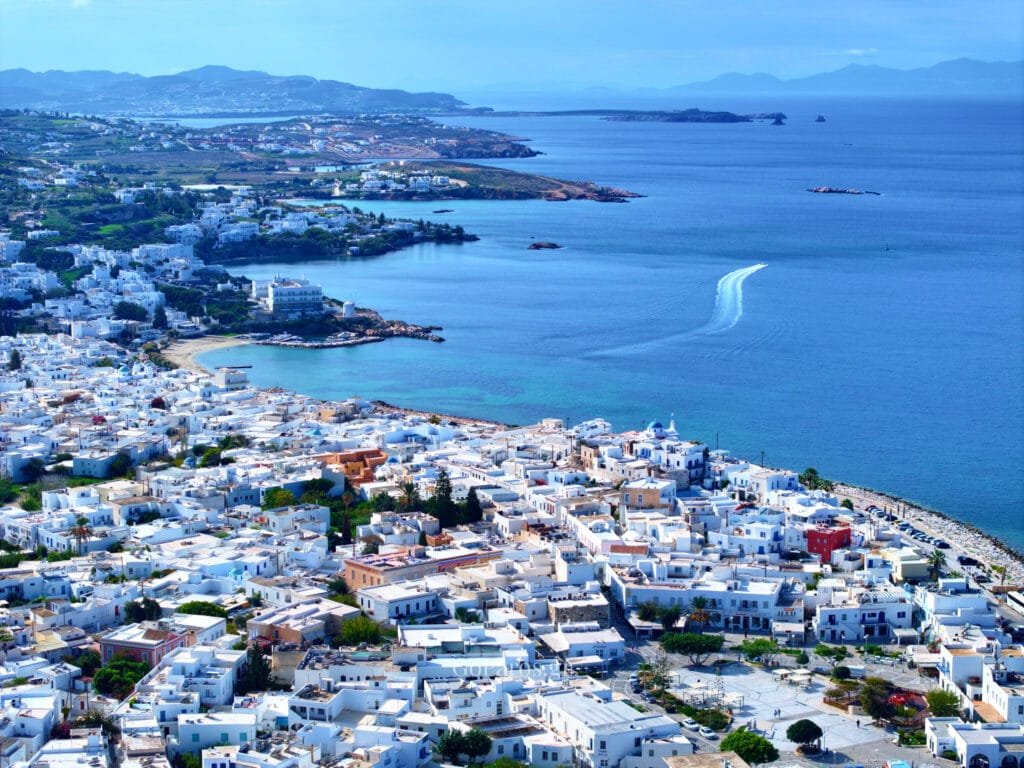
Parikia is the capital and main port of Paros, and the everyday heart of the island. This is where locals come year round to do errands: banks, post office, lawyers, accountants, utilities, everything is based here. The town is built around a small hill with the remains of a medieval castle above the harbour, and narrow, paved lanes winding through whitewashed houses, small churches and shaded courtyards.
Just behind the waterfront you will find the important church of Panagia Ekatontapiliani, the Church of 100 Doors, one of the most significant early Christian churches in Greece. The historic core is compact and great for wandering: small shops, cafés, quiet corners and glimpses of the sea.
In July and August, Parikia gets hectic. Driving straight into the centre is stressful and often pointless. The smart move is to park on the peripheral roads or in the designated parking areas around the outside of town and then walk in. In May, June and September it is much more relaxed and easier to navigate by car.
Parikia works well as a base if you want:
- Easy access to ferries and bus lines
- A mix of practical services and old town charm
- A real town feel rather than a pure resort
Locals do not necessarily think of Parikia as the most authentic experience anymore, but for visitors without a car it is a very practical and central place to stay, especially outside the absolute peak weeks.
Nearby swim options: Livadia Beach is the easy town beach, while Krios and Marcelo are great for a proper beach afternoon without going far.
Naoussa

Naoussa sits on the north coast and has grown from a fishing village into the most cosmopolitan spot on Paros. Around the harbour you still see traditional wooden fishing boats and classic Cycladic houses, but squeezed in between them are restaurants, bars, boutiques and late night spots.
By day, Naoussa feels bright and photogenic: white alleys, little squares, tiny chapels, small shops and seaside terraces. At night, especially after 10 or 11 pm in high season, the energy jumps about ten notches. The narrow lanes and harbour area turn into a dense, walkable nightlife zone, like a compact, concentrated Mykonos.
Parking in Naoussa, like in Parikia, is best done on the outer edges. There are designated parking areas a little above the village where you can leave the car and then walk down into the centre. Once you are inside the old village, you move on foot only.
Naoussa is a good choice if you want:
- A very pretty village with lots of bars and restaurants
- Strong nightlife in July and August
- Plenty of grocery stores and everything you need within walking distance
- To stay without a car and use buses and taxis
From a local point of view, Naoussa is the number one tourist trap on the island: crowded, expensive and very different from the quieter side of Paros. But it is absolutely worth experiencing at least once, both by day and especially at night for the atmosphere, photos and people watching.
Nearby beach loop: Kolymbithres, Monastiri, Santa Maria and Agioi Anargyroi are the classic picks close to town.
Lefkes
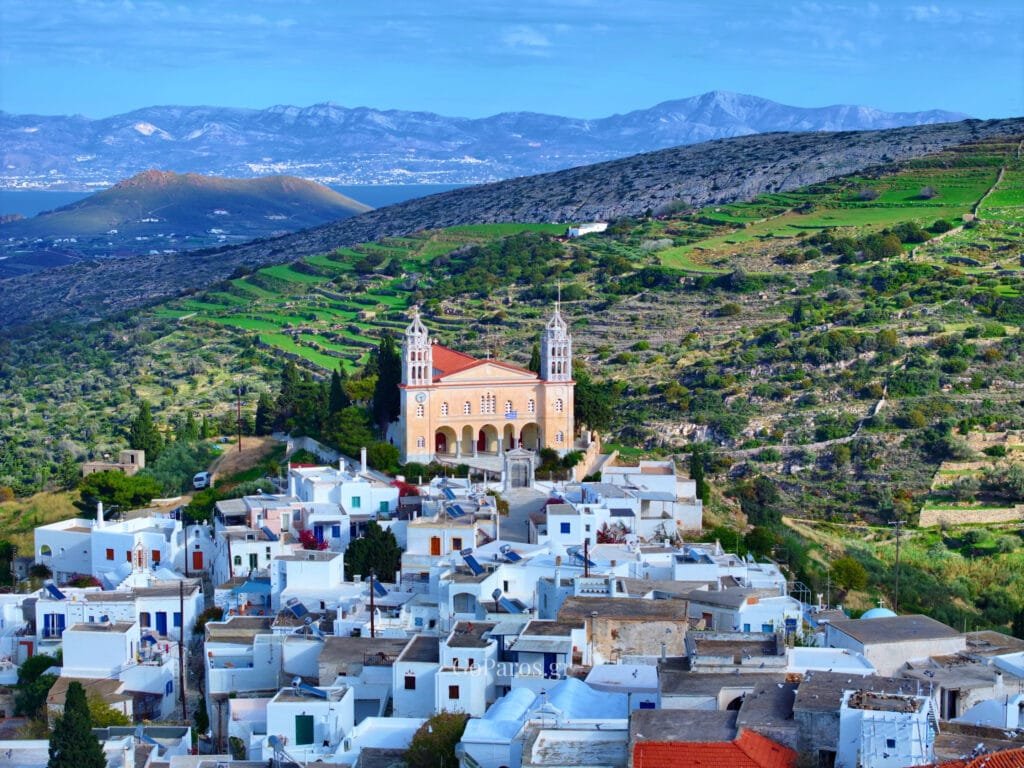
Lefkes is a traditional mountain village in the centre of Paros and, for many people, the most picturesque village on the island. White houses and stone paved alleys climb the hillside, framed by olive groves and pine covered slopes, with wide views down toward the sea and Naxos on clear days.
The village has a very strong Cycladic character: little squares, small churches, marble details and corners that feel untouched by the busier coastal scene. It is exactly the kind of atmosphere people imagine when they think of an authentic Greek island village.
One of the big draws here is the start of the Byzantine Road, an old stone path that connects Lefkes to Prodromos. The route is medium difficulty. Almost everyone can manage it with a bit of willpower. At a slow, relaxed pace, it takes about one to one and a half hours one way. It is a gentle rural walk through terraces, small chapels and fragrant herbs.
Parking is best done on the road that runs above the village, the peripheral road that continues up towards the mountain and antennas. That is where most people leave their cars. From there you walk down into the village. Around 95 percent of the settlement itself is not car accessible, so you explore everything on foot.
The best time of day to be in Lefkes is in the morning and late afternoon into evening. It is cooler and more comfortable for walking up and down the alleys to the main church, and you get both daytime views and that softer evening light when the village really comes alive with cafés, tavernas and people. It is romantic, atmospheric and definitely one of the must see villages when visiting Paros.
Marpissa
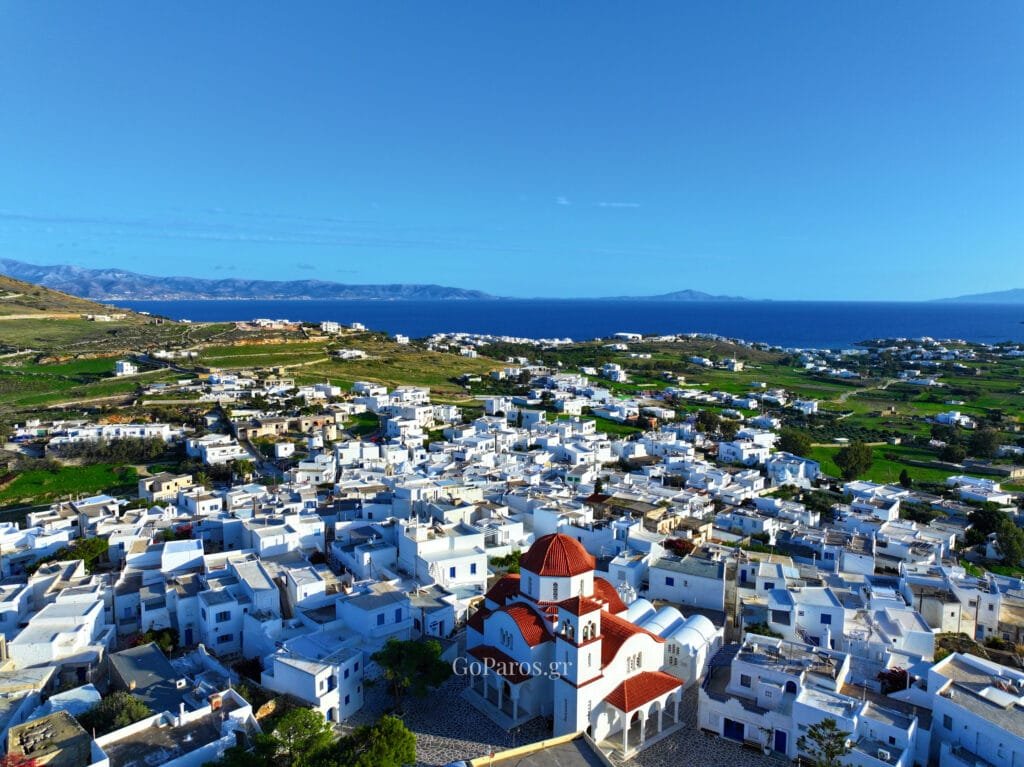
Marpissa is another traditional inland village, often considered second to Lefkes in terms of looks, but still very charming. It climbs up a small hill, with narrow lanes, churches and old houses tightly packed together.
In the centre you will find a large church and some nice local spots to eat, traditional tavernas and places for meze rather than anything fancy. Marpissa also has a bigger supermarket that serves many of the surrounding villages, so it is a practical stop as well as a scenic one.
As with almost all Paros villages, you should park on the edge of the village and walk in. The inner streets are too narrow for normal traffic and are best enjoyed on foot anyway.
Marpissa is a good stop if you enjoy:
- Traditional village atmosphere without heavy tourism
- Simple local food in a low key setting
- Combining a short village walk with a drive to nearby beaches
Easy nearby beaches: Piso Livadi Beach and Logaras are close, and Golden Beach is an easy next stop by car or scooter.
Piso Livadi
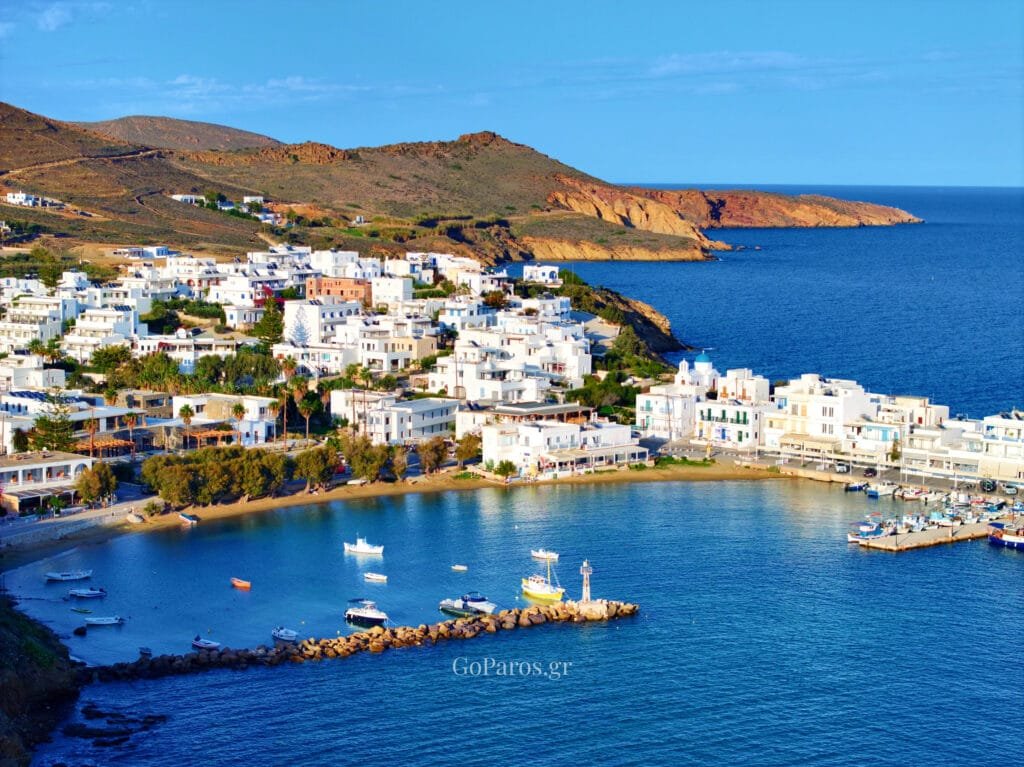
Piso Livadi is a small harbour village on the east coast. Fishing boats and excursion boats moor in the little port, there is a small sandy beach, and a line of tavernas sits right along the seafront. It has kept a very authentic fishing village vibe.
In July and August it gets busy, but still feels much more relaxed and small scale than Naoussa. Ideally you park in the designated parking area just outside the core of the village, unless your accommodation provides private parking in the centre.
Nearby beaches include Logaras, which you can reach on foot, and, if you are willing to walk more, you can get to Punda Beach as well. With a car or scooter, you are well placed for the whole east and southeast coast.
Piso Livadi can work as a base even without a car, because the bus system in summer is very good. You can be right on the water, walk to the beach and tavernas, and use buses to reach Naoussa or other parts of the island. In high season, buses to and from Naoussa run late into the night, all the way through to early morning, so it is realistic to go out there and come back on public transport.
Drios
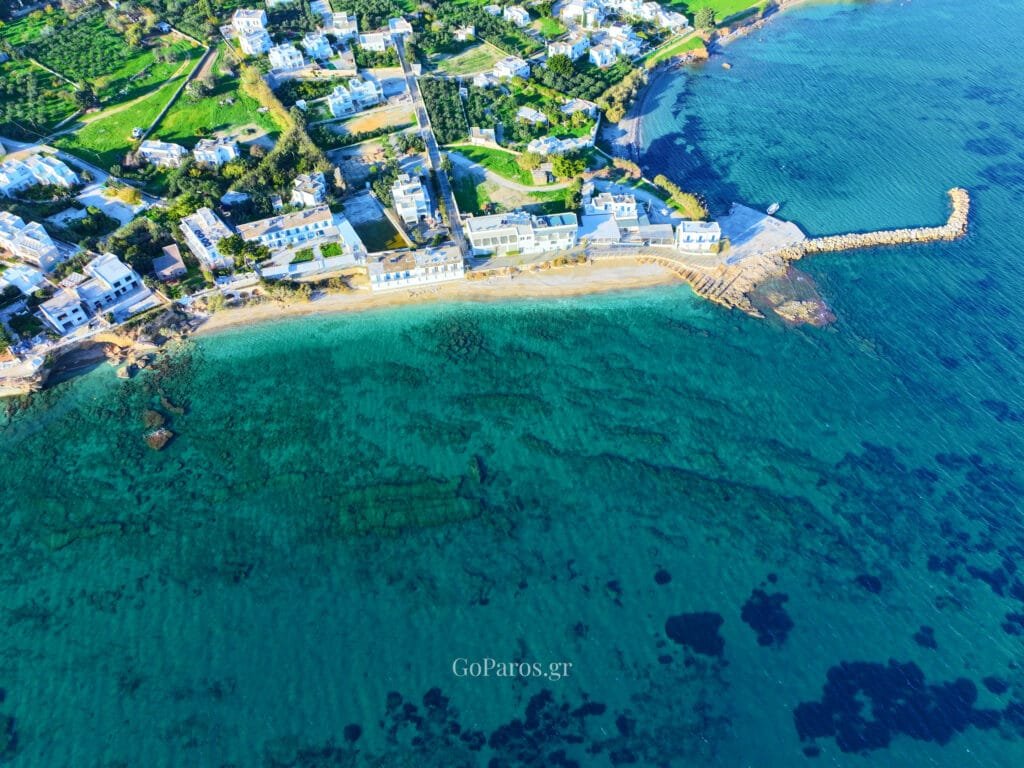
Drios, also written Dryos, on the southeast coast, is one of the most genuinely calm and classy fishing villages on the island. It is a bit of a hidden gem. It has a low key seafront, small beaches and a very relaxed rhythm.
Buses between Parikia and Drios run roughly every hour in the summer, which makes it possible to stay here without a car, especially if you are happy to spend a lot of time nearby. But if you want to explore more, a car or scooter opens up a whole cluster of excellent beaches very close by: Golden Beach, Drios Beach, Pyrgaki, Lolantonis, Logaras, Kalogeros, Molos and many other nearby spots. You can see how these compare in our Paros Beaches Guide.
All of those between Drios and Aliki spots share one issue. There is no direct bus line connecting Drios to Aliki, so many of the best hidden beaches on that stretch are really only practical with your own wheels.
Drios is an ideal base for people who:
- Want something quieter and more low key than Naoussa or Parikia
- Like being near some of the best beaches on the island
- Do not mind relying on a car or scooter to explore fully
Aliki
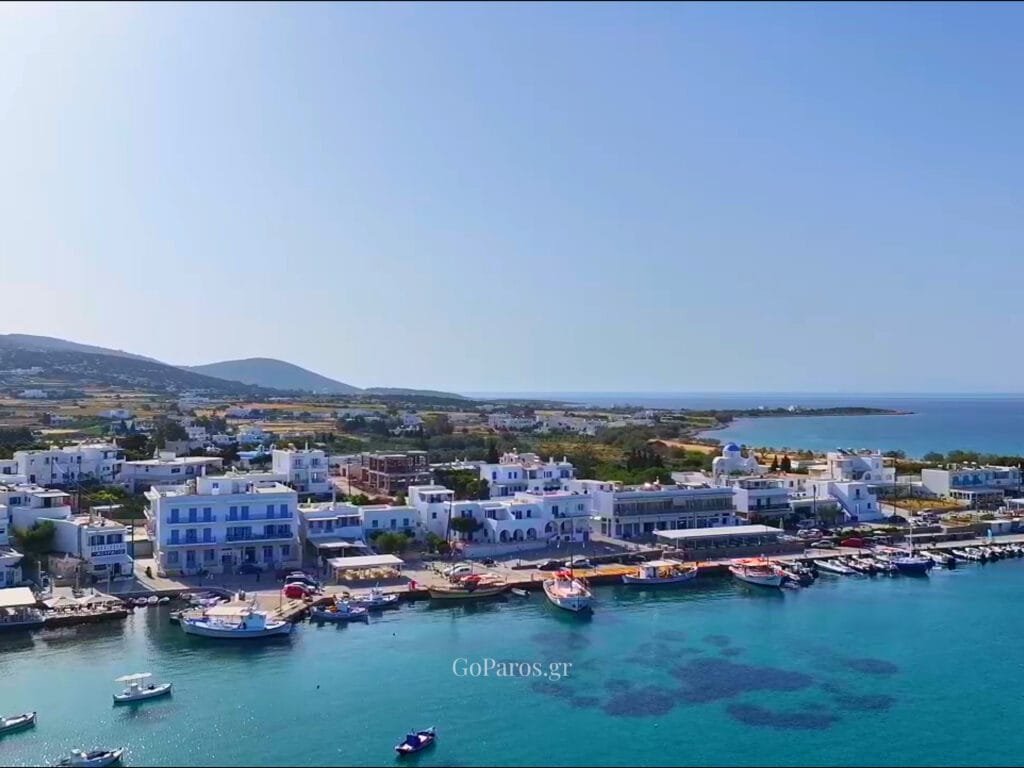
Aliki, on the southwest and south coast, feels a bit like the new Piso Livadi, bigger in size, but with a similar small village by the sea character. It has a harbour, sandy beaches and seafront tavernas that stay very close to their fishing roots.
Compared to Piso Livadi, Aliki has even less nightlife. This is a place for swimming, lazy beach days and long meals right by the water rather than bar hopping. The atmosphere is calm, authentic and very appealing for families and couples who want to slow down.
Aliki is also one of the main starting points for boat tours around Paros and nearby islands. Most organised boat trips on the island depart from Parikia, Naoussa, Piso Livadi and Aliki, so staying here gives you easy access to some great days on the water.
Nearby beaches: Agios Nikolaos, Aliki Beach, Piso Aliki and Makria Miti make it easy to build a full week of swims without long drives.
Prodromos
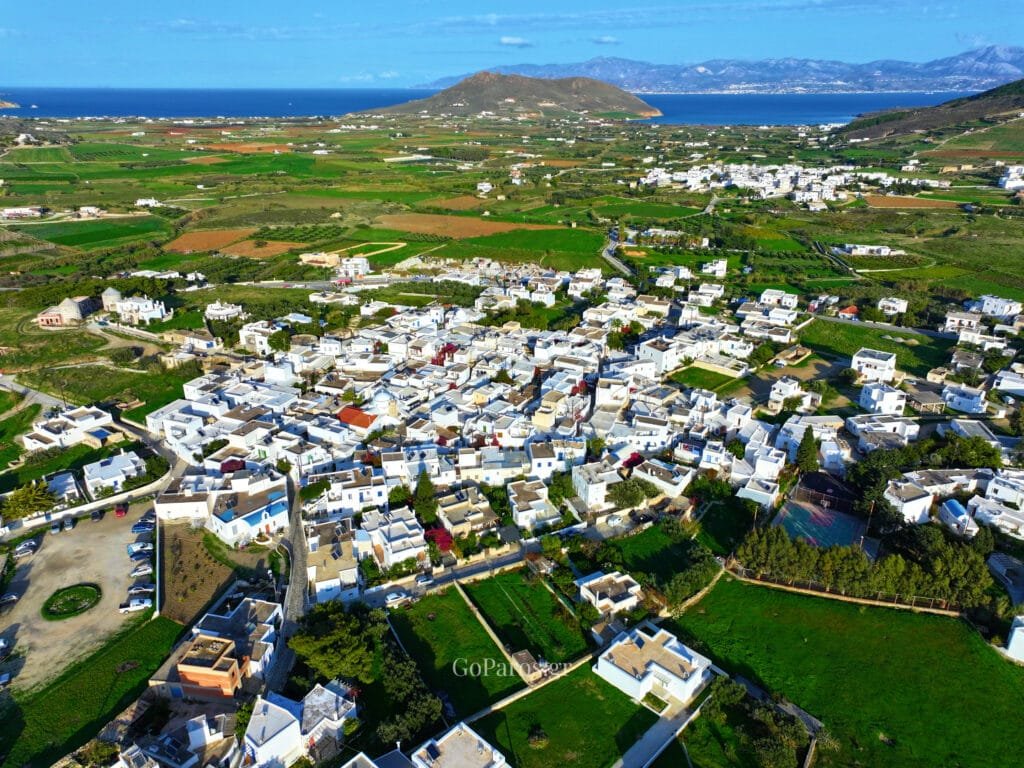
Prodromos is another small, traditional village not far from Lefkes and Marpissa. It is often linked with the Byzantine Road hike. Many people walk down from Lefkes and finish in Prodromos, entering through a stone gateway into a compact maze of alleys.
Inside, you will find quiet streets, small tavernas and corners that feel very local and unpolished. It is the kind of place you come to for a simple meal, some photos and a slow wander rather than a checklist of sights.
As usual, you park on the edges and walk in. Think of Prodromos as a bonus stop on a Lefkes or east coast day, a place for food, photos and a feel of everyday life.
Marmara
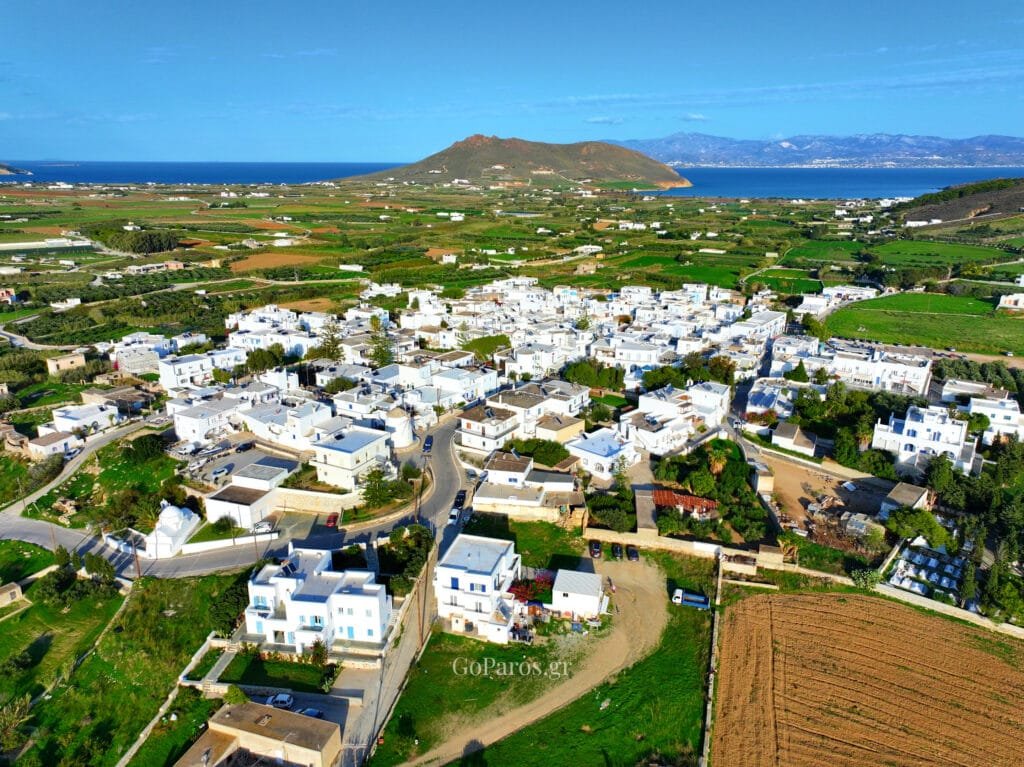
Marmara is another small inland settlement, surrounded by fields, vineyards and olive groves. It offers a taste of Paros’ interior: scattered farmhouses, simple churches and a slower, agricultural rhythm.
As with Kostos, Marmara is best seen as a secondary stop if you have extra time and are already exploring the area by car or bike. You come here to:
- Walk through peaceful streets
- Stop for a coffee or small bite
- Watch locals sitting outside in the late afternoon, chatting and enjoying the shade
Again, you park on the outskirts and visit on foot. It is less about sights and more about soaking in quiet everyday life.
Kostos
Kostos is a small inland village with a very local, rural feel. Whitewashed houses, a few churches and narrow lanes cluster around the main square, where you will see locals sitting for coffee, chatting and watching life go by.
It is not a must see for first timers, but it is a lovely stop if you have extra time or you are doing an inland loop. Kostos is perfect for:
- An afternoon coffee or meze
- A short walk through quiet alleys
- Seeing a village that still feels mostly untouched by tourism
Park on the edge and wander in, just like the other traditional villages.
Exploring the Villages: Practical Tips
Distances and driving
A full loop of the island by car takes about 1 hour and 15 minutes without long stops. Most village to village drives are 5 to 15 minutes. The longest typical cross island drive, Parikia to Drios, is roughly 25 to 30 minutes in normal traffic.
This makes it easy to combine a hill village and a couple of coastal villages in the same day without feeling rushed, as long as you avoid driving into the densest parts of Parikia and Naoussa at the worst times in peak season.
Getting around by bus
In summer, buses run frequently and cover most key points. Parikia and Naoussa are the main hubs. Many routes start and end there.
You can realistically stay anywhere on the island and get around by bus if you are patient and do not mind working around timetables. The big weak spot is the southern stretch between Drios and Aliki. There is no direct bus, so you have to connect via Parikia, which turns a short drive into a much longer journey.
Tickets are very affordable, from well under a euro for short hops up to just three euros for the longest distances like Parikia to Drios.
Getting around with a vehicle
If you can, having your own vehicle changes everything. A car gives you access to:
- Off the beaten path spots in the hills and countryside
- Quiet coves and beaches the bus does not reach
- Faster, more flexible village hopping in a single day
Scooters are also very popular in summer and work well for shorter distances, but you still have to be careful with wind and traffic.
You can absolutely do Paros without a car, especially if you base yourself in Parikia or Naoussa. But if you want to explore off road areas, more remote beaches and small inland villages, a car (or scooter if you are experienced and licensed) makes the island much more comfortable and efficient to explore.
If you want to browse options, start with Rentals In Paros.
Choosing your side of the island
- North and Naoussa area: best if you want lively evenings, lots of restaurant and bar choices, and access to north coast beaches.
- Parikia area: practical and central, good without a car, and the year round working heart of the island.
- East and southeast: around Piso Livadi and Drios, many locals consider this the best mix of beaches, authenticity and price, especially if you do not care about heavy nightlife.
- South and Aliki area: quieter, family friendly, and often calmer at sea under the usual summer north winds.
When northerly winds blow, which is most of the summer, the south and southeast coasts are usually more protected. On the rare days when a strong south wind hits, you simply flip your plan and aim for beaches and villages on the north side instead.
Best villages in Paros if you do not rent a car
You can do Paros without a car, as long as you choose your base wisely. The easiest places without a vehicle are Parikia and Naoussa, since they are bus hubs and you can walk to everything you need.
Lefkes is also possible without a car and gives you the most authentic inland experience, but keep in mind it is a bigger, steeper village and carrying luggage up and down is not fun for everyone.
On the coast, Piso Livadi, Drios, Marpissa and Aliki can all work without a car in summer, because buses are frequent and each has basic services and beaches nearby. The only catch is that if you stay in Aliki or Drios you are a bit cut off from the rest of the south and southeast by bus. You can still reach those areas by public transport, but it usually adds at least 30 to 60 minutes of extra travel time compared with driving.
Best villages in Paros for families
Families have a lot of good options on Paros. For a mix of facilities and energy, Naoussa works well, especially if you want to be able to stroll, eat and grab ice cream in the evenings, then take buses or short drives to beaches during the day.
For a calmer base close to some of the island’s best beaches, Drios is excellent. From there you have Golden Beach, Drios Beach, Pyrgaki and other sandy stretches very close by.
Piso Livadi and nearby Logaras are also solid family choices, with a small harbour, an easy village beach, and more beaches within walking or very short driving distance.
Aliki is another top pick for families who want quiet, shallow swimming and a strong small village feeling, with tavernas right on the water.
In the hills, Marpissa can also work for families who like a traditional inland village base and do not mind a bit of driving to reach beaches.
Best villages in Paros for nightlife
If nightlife is your priority, Naoussa is number one. It is the busiest and most cosmopolitan village on the island, with bars and clubs for all ages, and evenings that really start after 10 or 11 pm and run well into the night in July and August.
Parikia comes second. It has a more low key mix of bars and cafés along the seafront and in the back streets, with a variety of ages and a more relaxed, less sparkly feel than Naoussa.
On a smaller scale, Piso Livadi has a handful of restaurants and a couple of bars, which is enough for people who want to stay local and still have a drink by the water after dinner. Drios is similar in spirit: a few good tavernas, a beach bar, and a more laid back vibe for those who like to keep things close to home, with the option to bus or taxi to Naoussa or Parikia on bigger nights.
In reality, every village on Paros has tavernas and meze places that serve drinks, so if you prefer to stay close, you will always find somewhere to sit with a glass of wine or a cocktail. Everything is close here anyway.
Best villages in Paros for a quiet, authentic stay
For a quiet inland stay, Lefkes is the most authentic and romantic village. It has strong Cycladic character, views and a slower rhythm once day visitors leave.
On the coast, Drios is probably the calmest sea village to base yourself in during summer. It stays more low key than Naoussa and Parikia, while still having excellent beaches and tavernas nearby.
Aliki is also very quiet and authentic, with a strong small fishing village feeling. The only downside is that it is the least connected to the rest of the island by bus, so it is perfect if you have a car or if you are happy to stay mostly local.
If you have extra time and really love slow, local life, inland villages like Kostos and Marmara are lovely for an hour or two of coffee, meze and people watching, even if you do not stay there overnight.
Once you have a feel for the villages, check our Things To Do In Paros guide to plan beach days, hikes, food stops and more around your base.
Paros Villages: FAQs
Which villages should I see first?
Naoussa for evening energy and photos, Parikia for the old town and Ekatontapiliani, Lefkes for mountain charm, plus Piso Livadi and Drios for slow seaside time. See the full Paros villages guide.
Where should I stay on a first trip?
For no car, Parikia or Naoussa. For quieter stays near beaches, look at the east and south coasts around Golden Beach, Drios, Aliki, Logaras, Piso Livadi. Use where to stay in Paros.
Can I see villages without a car?
Yes. Buses connect the hubs and main villages. For custom timing or late evenings, book private transfers in Paros.
How busy are Naoussa and Parikia in July and August?
Very busy at night. Park on the perimeter and walk in. Shoulder months are lively and manageable.
Easiest village plan with kids?
Late afternoon in Lefkes for cooler temps, then a simple dinner in Piso Livadi or Drios. Add a protected beach from best beaches in Paros.
Which villages feel most authentic and quiet?
Lefkes, Marpissa, Prodromos, and the coastal pair Drios–Logaras outside peak hours.
How long is the Byzantine Road walk?
About 45 to 90 minutes between Lefkes and Prodromos, mostly stone path with gentle ups and downs. Wear decent shoes and bring water.
How long to cross the island?
Most drives are 5 to 10 minutes. From one side to the other side of the island is about 25 to 30 minutes by car/scooter, 1 hr by bus.
Best time of day for Lefkes?
Late afternoon into evening is cooler and romantic, with nice light and open cafés.
Any bus gaps I should know?
The south coast leg between Drios and Aliki is not directly linked by bus. Route via Parikia or use private transfer.
How many villages can I see in one day?
Two or three is comfortable. For more, pick a private island tour in Paros by car or van so you relax between stops.
How do villages connect with beaches and tours?
Pick a base with easy beach access, add a day of boat tours in Paros, then one or two experiences in Paros. Use best beaches in Paros to match the wind.
What To Do Next:
Use this guide to turn village walks into easy days out.
- Pair routes with swims from Best Beaches In Paros.
- Add a day at sea with Boat Tours In Paros.
- Book Experiences In Paros like cooking or pottery between strolls.
- Choose your base in Where To Stay In Paros.
- Get around with Private Transfers In Paros or Rentals In Paros.
- Hop further with Day Trips From Paros if you want more variety.